Thursday, April 3, 2014

Featured Artist Profile: Linda Filby-Fisher

Today I'm thrilled to present the work of Linda Filby-Fisher, one of our region's SAQA artists from Overland Park, KS.  I find her work and approach inspiring and hope you do too.  For more, check out her website at www.lindafilby-fisher.com.

1. Tell us a little bit about your artistic journey and how you got started?

In 1970 I was a psychotherapist and the director of a small neighborhood mental health center.  After consultation with my grandmothers [experienced needlewomen], I launched a quilting project for clients in our day treatment program, and also began my first quilt.  In 1987 I became a professional quilt maker, in 1989 a quilt artist, and in 1998 a collage fiber artist.
From the Outside In, A Seeing Way Series, Linda Filby-Fisher

2. How do you describe your work?

I am primarily a collage fiber artist with an art quilt base using mixed media to express a concept.  Text and poetry in many languages are an integral part of each piece.


3. Do you have any favorite techniques or approaches?

Photography has been and continues to be a significant element in the creative process.  And now, for the past few years, I have been very excited about various printing techniques--especially hand printing.  I am constantly learning; constantly looking for the method/the media that will best help me manifest the concept--to give the concept visual form.
Dignity 3, Quilt on a Frame Series, Linda Filby-Fisher
.


We Rise 1, Medicine Wheel Series, Linda Filby-Fisher


4. What do you want to communicate with your work?

It is important for me to bear witness, to bring a voice.  I am driven to add a certain energy to the Universe.  Each piece has a purpose; each is an offering----and the Medicine Wheel sings.
Earth Song 3, Medicine Wheel Series, Linda Filby-Fisher


5. What methods, or lifestyle tips, or time management tips do you find helpful to producing work?

It is important for me to work in the studio Monday - Friday for about 8 to 10 hours each day.  This is my time to create and to do the administrative tasks that are required to maintain a professional studio.  It is important for me to set aside time Monday-Friday for meditation, exercise, and reading--all are crucial to a productive workday.

Be curious, be interested, and listen in the silence.

Dignity, Celebration of Life Series, Linda Filby-Fisher

Dignity-Detail, Celebration of Life Series, Linda Filby-Fisher


6. What kind of studio/workspace do you have and what features of your surroundings are most helpful for your productivity/work?

My studio is now in my home--an old home with banks of wood windows that fill the studio with natural light and wood floors that make clean up of paint spatter and copper shavings easy.  A large worktable and a floor to ceiling design wall are surrounded by books [including a dictionary collection and Learning Journals], photographs, stones, twigs---special small things that quietly sing.

A place of vibrant peaceful energy.
From The Outside In 3, A Seeing Way Series, Linda Filby-Fisher

Leaving 6, A Telling Series, Linda Filby-Fisher

7. Which artists, other individuals or subjects currently inspire you?

Observations from daily life: a snippet of conversation, a brief glance at a profile--a stance--a gesture, all inform the work.  People's stories--their joys & challenges--their feet and hands--their music, the bend in a branch, the colors-the sounds, the stones and the earth, all bring form to the work.


Meditation insights, tongues of nations gone, words of poets and sages, microscopic and macroscopic science, all nurture the work.

Unity 5, Medicine Wheel Series, Linda Filby-Fisher

 Thanks so much to Linda for sharing her art and thoughts with us!


Tuesday, March 25, 2014

Upcoming Show: Ada Niedenthal and Elnora Nokes

Hi everyone, another great show update today.  Our regional SAQA rep Ada Niedenthal has an upcoming show the first weekend of June.  The show is at LoudRock Studio in Kansas City on June 6-7.

Here's the show info/background:


Ada Niedenthal, SAQA member, is a textile artist, and works with fabric.  Elnora Nokes is a collage artist, and works with mixed media.   They are having a Fundraiser/Art Show to support a couple of their favorite causes: Ada - Cross-Lines Community Outreach and Elnora - Kiwanis International Project Eliminate.  

LoudRock Studio, where the Art Show/Fundraiser is being held, is a very creative environment and photography studio, run by Aleksandra Nokes.

The show is for one week-end only:  June 6 and 7, 2014.


I hope those of you in the Kansas City area will stop by and check it out.

If there are any more upcoming shows you'd like to publicize, just e-mail me.

Thursday, March 20, 2014

Upcoming Show: Beyond Tradition

Hi all, I just wanted to pop in to say that I have several pieces in a SAQA New Mexico regional show called Beyond Tradition.  It's being held at the Hubbard Museum of the American West in Ruidoso Downs, NM and runs from April 5-September 1.  If any of you are traveling through southern New Mexico, you might check it out!


Tuesday, February 18, 2014

Ada Niedenthal Show at Lenexa City Hall Gallery

Hi all, our regional co-rep Ada Niedenthal just sent me these pictures from her recent show at the Lenexa City Hall Gallery in Lenexa, Kansas.  The show ran from through January of this year, and the pictures show some patrons taking a close look at the beautiful work.

Thanks to Ada for sharing, and please remember to e-mail me if you have announcements about upcoming shows or pictures/information to share!


Tuesday, January 14, 2014

Featured Artist Profile: Jean Brueggenjohann

Hi everyone and welcome to 2014! I hope everyone survived the holidays and year end business and can dive into art with a relish. Today I'm thrilled to share a little more about one of our fabulous Missouri artists, Jean Brueggenjohann.  I love her use of bold geometric shapes to create a feeling of place, as well as a sense of depth and texture.
  

1. Who are you and where do you live?

I am a professional graphic designer and professor of Art in the Graphic Design Media Area at the University of Missouri–Columbia, MO. I work in the graphic design field designing mostly books and other print material for non-profits and art museums. I have been making quilts since 1991.


Jean Brueggenjohann, Window to Enchantment-I wanted to do a really elaborate and fantasy-like quilt.


2. Tell us a little bit about your artistic journey and how you got started?

My grandmother, great grandmother, aunt and great aunt were seamstresses, tailors and all were quilters. My mom is an excellent seamstress and I learned to sew clothing at an early age from her. I took my first quilt class in 1991 and found that I loved the similarity to graphic design working with cloth. I received a Sabbatical in 1994 when teaching at California State Northridge in Los Angeles to create a letterpressed small edition book but the Northridge Earthquake happened and the Fine Arts Building was destroyed. Instead I made my first art quilts using fabric paint for my Sabbatical. 


Jean Brueggenjohann, Four Square Third Leave–Hand set letterpress printed type on antique textiles and feed sacks. Text is a post civil war children’s rhyme.

Jean Brueggenjohann, Reminiscent of the winter sunsets in central Missouri. First illustrative quilt.


3. How do you describe your work?

My work is usually a combination of traditional piecing, applique and using unusual materials such as dyed fabric, tulle, letterpress printed typography, beading, sequins and embroidery. Mostly, I like the interplay of traditional and nontraditional techniques, design and materials.


Jean Brueggenjohann, Enchanted Evening-Continuing the theme with a more elaborate landscape. I made 12x12 inch blocks for easy quilting because I had tendonitis in my shoulder.


4. Do you have any favorite techniques or approaches?

Most recently I have been making landscapes and I am most happy when using my sewing machine so I do most of my work using the machine. I do hand work as needed mostly paper piecing applique making my own patterns and designs. When I lived in Los Angeles I took adult education quilt classes at the local high school with a wonderful teacher, Rita Streimer. She researched every technique you can image for class and I learned so much from her. The quilting techniques I learned gave me the freedom to create almost anything I want in my quilts.

Jean Brueggenjohann, Enchanted Baskets

5. What do you want to communicate with your work?

I don’t really have any idea about what I want to communicate. I feel like my quilts are pretty clear about what they are.

Jean Brueggenjohann, Enchanted Jungle-The outer blocks made with African fabric were left over from another quilt. I made the center design to go with them.

6. What methods, or lifestyle tips, or time management tips do you find helpful to producing work?

I treat quilting like my design work. I make pencil sketches and keep a sketchbook for ideas. I think about the ideas and when the time is right the quilt comes together. I do not worry about getting things done on any time frame and usually have several quilts going at the same time. I am a big believer in planning and using grid paper to refine my sketches and then I blow up my sketches to the correct size at a local blueprint shop. I tack this full size paper sketch to my design wall and I have a precise sketch to follow. I used this method for all the landscapes. For traditional pieced quilts I just stick to the small-scale sketches. I use my camera along the way to document and compare pinned variations of designs as I finalize the quilts. Occasionally, I make Illustrator or Photoshop sketches to work out the color and design. I always listen to music when I work, usually alternative rock.

7. What kind of studio/workspace do you have and what features of your surroundings are most helpful for your productivity/work?

I have a dedicated room for my quilt construction, sketching and cutting. I have a larger room, which used to be a family room that houses my design wall, long arm, cabinets and bookcases.


8. Which artists, other individuals or subjects currently inspire you?

I have been very fortunate to see lots of people and their work. When I lived in Los Angeles, I belonged to the San Fernando Valley Quilt Guild and during the early to mid 1990s we had just about anyone who was anyone in the quilt world as a guest speaker. It was inspiring to see such outstanding work. A turning point in my work came when Jinny Beyer was a guest speaker. I bought her book and made one of her intricate quilts. I realized that I possessed the skill to be a very fine technical quilt maker.

Jean Brueggenjohann, Rising Star-Traditional wall quilt.

9. Do you have a blog or website you'd like to share?

No blog or website. I work with students trying to make websites everyday in class and it is the last thing I want to do when I get home. I would rather sew. 

Thanks so much to Jean for sharing her work with us!  Please just let me know if you'd like to be featured in this space!

Friday, November 15, 2013

Featured Artist Profile: Janice Filler

Today I'm thrilled to bring you the work and comments of Janice Filler, one of our regional SAQA members from here in Oklahoma.  I was privileged to meet her and talk to her at the SAQA conference this spring in Santa Fe, and am so excited for you to all see her fabulous work.

1. Who are you and where do you live?
My name is Janice Filler, and I live in Oklahoma City.  I am the current state representative for the Surface Design Association (SDA), as well as a member of SAQA.

2. Tell us a little bit about your artistic journey and how you got started.
I learned to sew from my grandmother, who was meticulous and expert at garment construction and tailoring.  My mother taught me and my sister to crochet and embroider, which my sister mastered.  I got distracted in my college/medical school years and the following medical practice of pediatrics, but retirement found me dragging out my sewing machine.   I have very much admired beautiful traditional quilts, but after a “detail-oriented” profession, I was looking for something spontaneous and more liberating; I found my passion in art quilting/ surface design.  I love exploring new surface design techniques and hand-dyeing fabrics.

Doorway (Time Portal), Janice Filler 2011


3. How do you describe your work? 
Mostly pictorial, but often with humor or an ironic twist.

Vanishing Habitat, Janice Filler 2012
4. Do you have any favorite techniques or approaches?
I am an admitted technique-junkie when it comes to surface design.  Lately I have been interested in digital imagery and the use of transparency in design, whether by use of sheer fabric, or layers of color/design.  I find words or phrases to be inspirational, and frequently use them as I design my work, whether or not they are used literally in the work.  Sometimes, I focus on the less conventional meanings of words.


The Forest's Treasure, Janice Filler 2012


5. What do you want to communicate with your work?
Often irony or humor; sometimes the juxtaposition of different ideas, or just visually pleasing design in the unexpected medium of fiber.

Oklahoma's Sons and Daughters: Will Rogers, Janice Filler 2013


6. What methods, or lifestyle tips, or time management tips do you find helpful to producing work?
In a good week, I try to spend some time in the studio every day.  Most weeks, I don’t succeed, but feel most productive when I am able to do that.  It is helpful to my creative process to have an abundance of visual imagery around me, and I use my design wall partly for that purpose when it’s not in use for a current project.

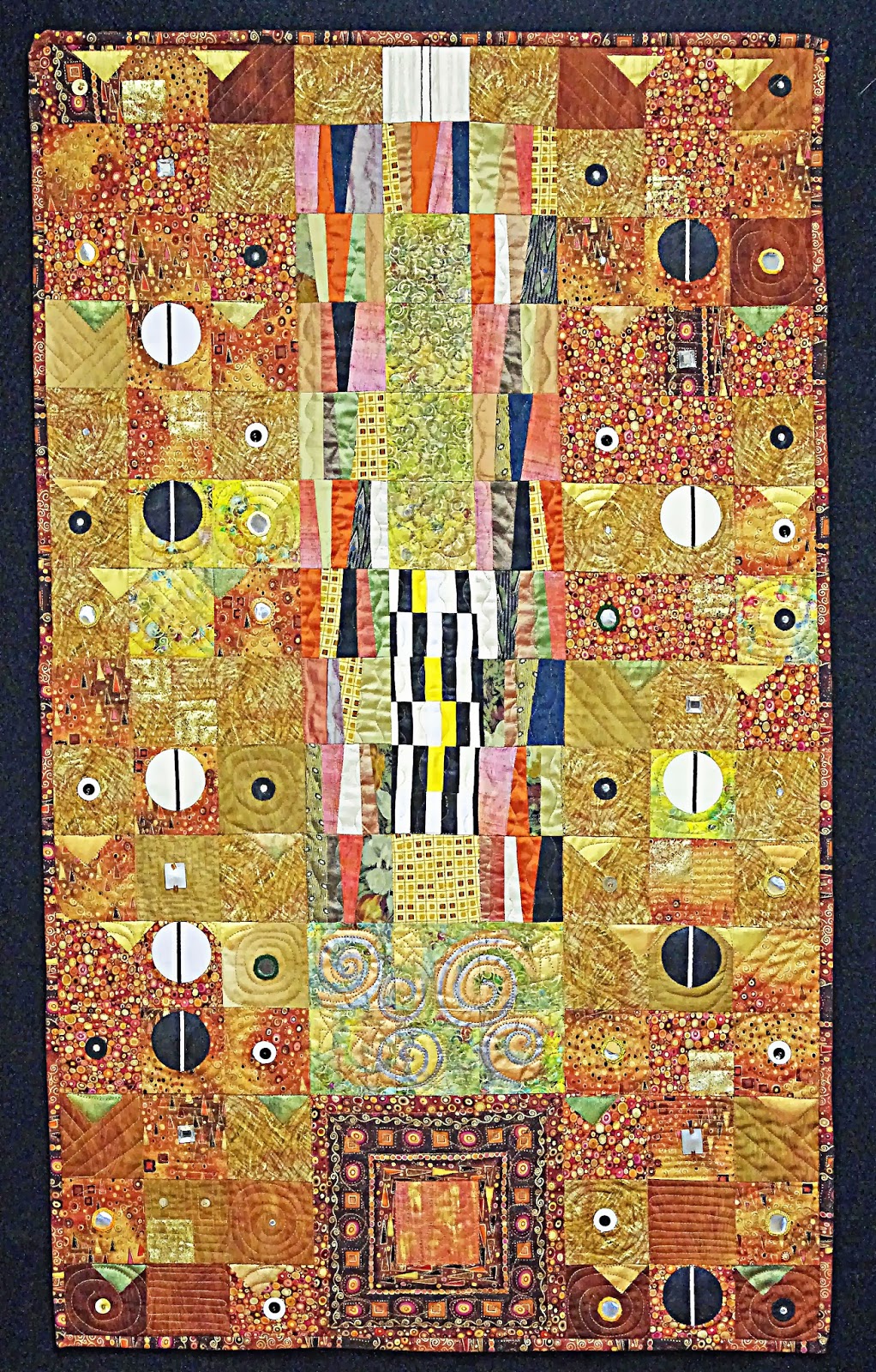
Nod to Gustav Klimt, Janice Filler 2009
7. What kind of studio/workspace do you have and what features of your surroundings are most helpful for your productivity/work?
I have a home studio with an inspiration/ design wall and areas set up for “wet” work, (i.e. sink, paint, dyes, refrigerator, microwave, elevated print table, silk screens, etc.) and for “dry” work, (i.e., cutting table, fabric storage, sewing/ felting machines, shelves for embellishments and thread, etc.).  I have a small “office” area with computer, wide-format printer, books, journals, etc.   A favorite is an automated massage chair in an alcove for “recovery” after a long day.


8. What artists, other individuals or subjects currently inspire you?
I am especially drawn to fiber and quilt artists who keep pushing their boundaries in art, especially in regard to the variety and manipulations of materials they use, and who think about using fiber media in non-traditional ways.

Profile (Tippi Hedren's Revenge), Janice Filler 2011
Thanks so much to Janice for sharing with us, and please let me know if you're interested in being a featured artist on the blog or have any announcements to share.


Friday, October 11, 2013

Featured Artist Profile: New co-Rep Cherrie Hampton

Update:  You guys!  I'm so thrilled to let you know that Cherrie's beautiful quilt Oklahoma Windsong (first one below), just won The Future Of Quilting Award at IQF Houston.  So fabulous!

Hi All,  today I'm super excited to share with you a little bit about our new co-Rep Cherrie Hampton.   Her work is just gorgeous, and has won many many awards. I had the pleasure of meeting with her recently and was thrilled and encouraged by her great ideas and enthusiasm.  I'm sharing her profile today and then later this month I think we'll have a post about our other co-rep, Ada Niedenthal.

Please remember to send me an e-mail if you're interested in being a featured artist on the blog.  It's not a complicated process and I'd love to see more participants share their work!

1. Who are you and where do you live?

My name is Cherrie Hampton and I am a native of Oklahoma City, OK.

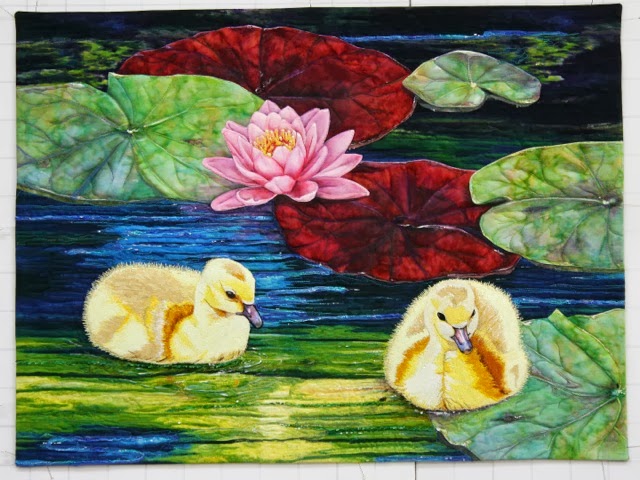
Oklahoma Windsong

2. Tell us a little bit about your artistic journey and how you got started?

Although I have been sewing and quilting for many years, art quilting is a new phase of my creative journey.  My formal career was as a college professor teaching singing, specializing in opera and musical theater.  I have designed and made numerous costumes and sets as well as training singers as actors.  These experiences formed the artistic eye that now guides my art quilting.


3. How do you describe your work?

I produce mostly small wall art quilts with construction techniques which are appropriate to the image concept.  I like for my work to be realistic and easily self-descriptive.  My theatrical training leads me to consider the impact of the quilt from a distance as well as the nuances of detail.

4. Do you have any favorite techniques or approaches?

Since taking up watercolor painting 4 years ago, I have found that painting on fabric has opened a new avenue for realistic expression.  I have used inks, pencils, fabric pens, crayons, acrylic paints, pretty much anything that allows me to apply color to fabric.  I also use commercial fabrics in my applique process.


5. What do you want to communicate with your work?

I am daily renewed by the beauty of creation around me.  I strive for realism in my work because I want to share the colors, textures movement and images as I see them.  I am particularly interested in portraiture and some of my first efforts in art quilting have involved human images.


6. What methods, or lifestyle tips, or time management tips do you find helpful to producing work?

In my studio I have music playing most of the time.  My favorite "creative" music is gentle music with no words but with nature sounds laced throughout the melodies.  I find this type of music acts as an eraser of other thoughts and concerns and helps me enter into a peaceful mindset.

7.  What kind of studio/workspace do you have and what features of your surroundings are most helpful for your productivity/work?

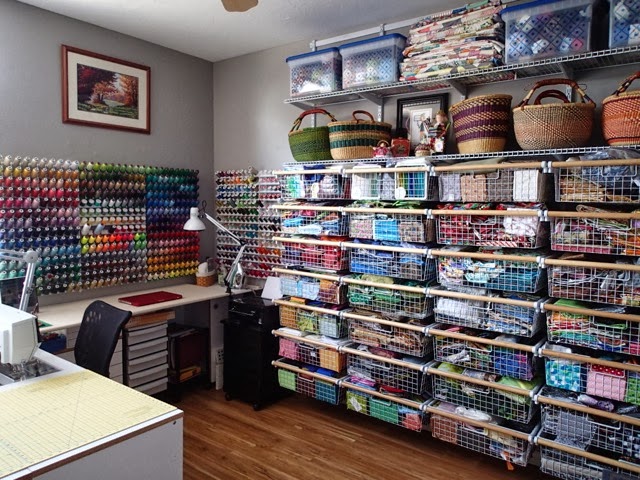
My studio has a large north window and is arranged with two work spaces, one for sewing and cutting and the other for painting.  I view my work much as one would a stage setting, and for that reason my design wall is my most important creative tool.  I tis located across one entire wall of my stuido directly across from the sewing machine. I also draw inspiration and energy from my wall of threads which is arranged in color families and my wall of fabric held in open baskets.  I am surrounded by rainbows of color.


8.  Which artist, other individuals, or subjects currently inspire you?

I am constantly searching blogs to understand other artists' methods and works.  These research soirees have helped me to begin to develop my own voice and preferences as an artist.  It is also interesting to find other artists with similar voices and  inspirations.  I have learned so much about how to create my own art and how to be an artist by observing Velda Newman, Patt Blair, and Maria Elkins.  I am also challenged by BOB, a small group of quilt artist who meet monthly.


Thanks so much to Cherrie for sharing and for stepping up as our co-rep.  Please feel free to e-mail her or Ada with ideas about what you'd like to see our SAQA region do.  You can e-mail Cherrie (her info is on the left sidebar) or check out her blog, http://windsongquilts.blogspot.com/